Friday, 1 December 2017
Thursday, 30 November 2017
Monday, 20 November 2017
Wednesday, 15 November 2017
Wednesday, 8 November 2017
Tuesday, 7 November 2017
Monday, 6 November 2017
Filming Location Prod. by Isaac
Me and my partner have debated on where we are going to film our music video and we have decided to film in Leicester near the University of Leicester
Friday, 20 October 2017
Friday, 6 October 2017
Monday, 18 September 2017
Monday, 11 September 2017
Are Music Videos Profitable? Results Prod. by Isaac
I had created a survey to see whether people believe music videos are still profitable or whether they are outdated.
https://www.surveymonkey.com/results/SM-TF9XHFV88/
Friday, 8 September 2017
Audience: Psychographics Prod. by Isaac
Media institutions are constantly searching for more detailed audience profiling - so they can target their product more successful.
These include VALS (values, attitudes and lifestyles) or Mosaic consumer classification. They can also use Psychographics.
Psychographics
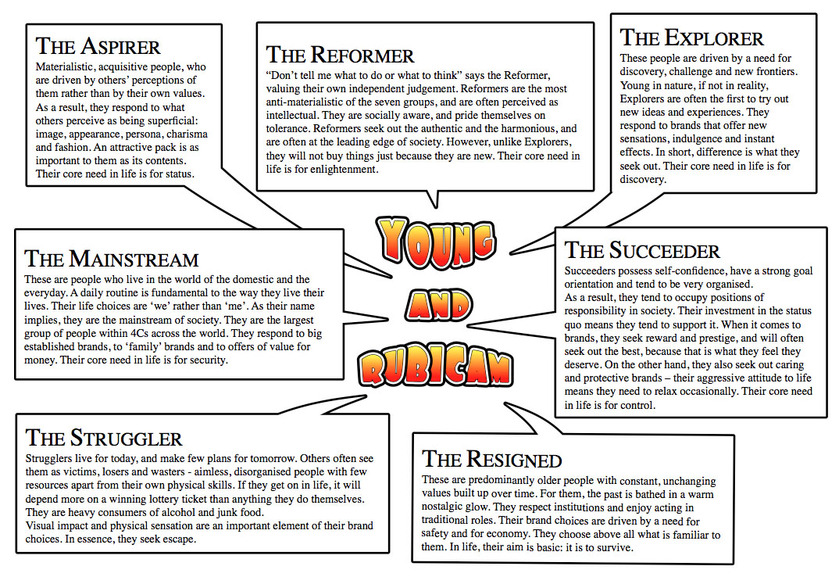
Young and Rubicam invented a successful psychographic profile known as their 4Cs Marketing Model: Cross Cultural Consumer
Characterisation. They suggested people fit into one of seven groups:
Resigned: Rigid, strict, authoritarian and chauvinist values, oriented to the past and to resigned roles.
Strugglers: Alienated, struggler, disorganised - with few resources apart from physical/mechanical skills. Excessive consumers of alcohol, junk food and lotteries, also trainers. Brand choice involves impact and sensation.
Mainstreamers: Domestic, conformist, conventional, sentimental, passive, habitual. Part of the mass, favouring big and well known value for money 'family' brands. Almost invariably the largest 4Cs group.
Aspirers: Materialistic, acquisitive, affiliative. Image, appearance, charisma, persona and fashion. The packaging is more important than the quality of the contents.
Succeeders: Strong goal orientation and confidence. Good work ethic and organisational skills. Stability.
Explorers: Energy- autonomy, experience, challenge, new frontiers. Brand choice highlights difference, sensation, adventure, indulgence and instant effect- the first to try new brands.
Reformers: Freedom from restriction, personal growth, social awareness, value for time, independent judgment, tolerance of complexity, anti-materialistic but intolerant of bad taste. Curious and enquiring, support growth of new product categories. Select brands for intrinsic quality, favouring natural simplicity, small is beautiful (Higher Education).

Thursday, 7 September 2017
Thursday, 6 July 2017
Thursday, 29 June 2017
Frith and Archer's Theory Prod. by Isaac
Frith
Music videos can be characterised by three broad typologies: performance, narrative and conceptual.
Narrative: A video can tell any kind of story in linear, cause effect sequencing. Love stories are the most common narrative mode in a music video and typically follows the generic pattern of boy meets girl, boy loses girl, boy gets girl back. Action in the story is dominated by males who do things while the female sits passively reacting or waiting for something to happen.
Performance: Performance videos that display the star or group in the studio remind the viewer that the soundtrack and album are still important. The aim is to convey a sense of the in-concert experience.
Conceptual: Conceptual videos do not tell a story a typical linear one would, but rather done by creating a mood. This makes a feeling to be evoked in the experience of viewing. These videos make significant use of the visual element.
Archer
-There needs to be a strong and coherent relationship between narrative and performance in music videos.
-Music videos will cut between a narrative and a performance of the song by the band.
-A carefully choreographed dance might be part of the artist's performance or an extra aspect of the video designed to aid visualization and the 'repeatability' factor.
Goodwin's Theory On Music Videos Prod. by Isaac
Goodwin's Theory
Goodwin's theory is based on 8 main principles, these are:
-Links between lyrics and visuals
-Links between music and visuals (complimentary, contradicting or amplification)
-Genre characteristics
-Intertextual reference
-Notions of looking (objectification of women)
-Performance based, narrative based or concept based music videos.
-Voyeurism (direct gaze, other people looking at the artists, insight into artists life, screens and mirrors)
-Demands of the record label (representation of the artist)
Lyrics and Visuals:
-Goodwin suggested that lyrics make constant references to the visuals on screen. Visuals therefore should reinforce what the lyrics say. For example, the song started from the bottom by Drake is a great example.
-The song is about how drake had very little when he was younger however now he is at the top of society. When he explains how he had very little when he was younger, the visuals would be on Drake when he was a child playing football.
-He would then rap the chorus where he states that he is now at the top. The visuals then cut to Drake in his many huge mansions and constant partying.
Genre Characteristics
-These are certain traits associated with a particular music genre. For example, an R&B music video would typically have many close-ups of the artists. This then adopts several characteristics of the genre and makes audiences associate with the video. You would typically expect a narrative based story in an R&B music video.
Notions of looking
-Notions of looking is all about how someone is seen.
-In the 21st century, there are a lot of music videos which have women in them and according to Goodwin, they are seen as objects.
-Men can also be seen as violent or cheats in music videos.
Demands of the Record Label
-A record label has the control over a new artist who has signed for them. It is up to the record label to decide how the artist should be perceived
Narrative based
-As well as being part of genre characteristics, it is also its own category according to Goodwin's theory.
-The narrative allows for the music to come to life just like a story.
-It connects all the dots within the categories that Goodwin identified.
-Narrative can either be fragmented or linear. Most of the music video's today, especially in R&B tend to be fragmented.
Tuesday, 27 June 2017
Maslow's Hierarchy of Needs Prod. by Isaac
Maslow's Hierarchy of Needs explores the idea that humans are motivated by certain needs, the most basic of which must be satisfies before the more complex ones can be achieved. The hierarchy can aid the media industry as it can help reach out to the audience about their ideas and products which can interact with their needs.
Psychological Needs:
(Breathing, food, water, sex, sleep, homeostasis and excretion)
At the start of the pyramid are the psychological needs. They are the basic elements that allow for humans to survive. These desires have been imprinted onto our very being as fear of death and consequently the desire to live and, if such as nutrition and sleep are removed we are almost always prepared to act in order to recover them. Therefore, it is only natural that these needs must be fulfilled before the mind or the body is able to concentrate on any more complex needs.
Safety:
(security of: body, employment, resources, morality, the family, health and property)
According to the pyramid, once the psychological needs have been met, someone is able to move onto the next stage, safety. The absence of security can result even war or famine in its worst case scenario. A sense of moralist is also necessary as the ability to tell right from wrong and to accordingly is crucial to the survival of society in the creation of a fair legal system.
Love/Belonging:
(Friendships, family and sexual intimacy)
After the first two stages have been met and achieved, the third section, love/belonging, deals with feelings of love and belonging. Neglect, ostracism and bullying can damage the individuals ability to maintain emotionally significant relationships between friends and family. Human beings are deeply social creatures who need to feel accepted in a variety of different communities and the absence of belonging can cause loneliness, depression and anxiety. The need for acceptance can also leave an individual giving into peer pressure.
Esteem:
(Self-esteem, confidence, achievement, respect of others)
Esteem is the human need to be valued by themselves and by others. A lack of esteem may result in an inferiority complex or depression, which in turn will stifle the individuals ability to increase their self-esteem. Maslow split esteem into two versions. The lower version being for respect from others, recognition and prestige whilst the higher version need deals with self-confidence, freedom, independence and self-respect.
Self-Actualisation
(Morality, creativity, spontaneity, problem solving, lack of prejudice, acceptance of facts)
The top tier of Maslow's theory is self-actualisation. This represents the individuals potential or rather the desire to become everything that they can be. In order to meet this need, the individual must first achieve and maintain the lower tiers.
Subscribe to:
Posts (Atom)